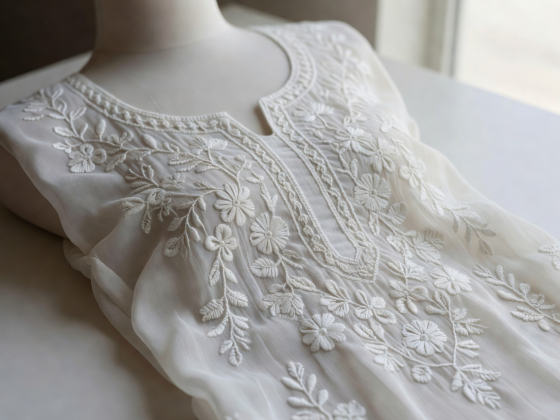
Legend attributes the refined elegance of Chikankari to Mughal Empress Noor Jahan, who introduced Persian needlecraft to the royal ateliers of Lucknow. Unlike heavy surface brocades, Chikankari is defined by its subtle, monochromatic white-on-white shadow stitching executed on muslin, organza, and fine mulberry silk.
1. The 32 Stitches of Lucknowi Craftsmanship
Master artisans in Lucknow classify Chikankari into flat stitches, embossed knots, and open-mesh jali work:
- Bakhiya (Shadow Work): Woven on the reverse side of transparent fabric in herringbone stitch, casting a soft, misty silhouette on the front facade.
- Phanda & Murri: Minute embossed French knots resembling millet grains or rice pearls, giving structural relief to floral centers.
- Tepchi: A brisk running stitch used for linear stems, foliate stems, and border outlines.
- Jali (Open Meshwork): Created without cutting the fabric; the needle pushes warp and weft threads apart, securing them into delicate microscopic lattices.
"A single authentic Chikankari kalidar anarkali with comprehensive Jali and Phanda needlework represents over 250 days of concentrated handcrafting by master women artisans in rural Awadh."
2. The Metallic Glow of Mukaish & Badla Embellishment
To elevate Chikankari for royal evening soirees, artisans incorporate Mukaish (also known as Badla or Kamdani). Slender flat ribbons of pure silver wire are threaded through the fabric and hammered flat with small cowrie shells to create luminous, metallic starlight dots (Fardi) across the garment.
3. Fabric Pairings and Modern Haute Couture Integration
Modern Indian couture houses have transitioned Chikankari from conventional white mulmul into sunset saffron, royal maroon, and pistachio green silks. Paired with pearl-encrusted corsets and velvet jackets, Chikankari is now a staple of global red carpet fashion.